

Jeff Bezos is the wealthiest man in the world with an astonishing fortune of a net worth of $177 billion. The founder of both Amazon, the world’s largest retailer, and Blue Origin, he undoubtedly is the richest man in the modern world. But what if we were to ask you about the wealthiest man in history? would you still answer Bill Gates or Jeff Bezos? Perhaps one could answer John D. Rockefeller, but all these trailblazers are nowhere near the rich legacy of the wealthiest person in history- Mansa Musa.
Mansa Musa, the 14th Century West African ruler was so rich that his mere gifts wrecked a whole country’s economy!
The exact date of his birth is unknown but it appeared that by 1324, he was a young man. Mansa Musa ascended to the throne in the early 1300s and he may have forged his accession theory according to modern historians. Musa’s predecessor Mansa went on an expedition to the Atlantic Ocean twice in his lifetime. On his second voyage he placed Musa as the caretaker of his kingdom, when Mansa didn’t return from his voyage, Musa was crowned the King of the Mali Empire in 1312.
Musa Keita I was a devout Muslim and possessed a wealth that possibly made him the richest person of his time. By the time of his coronation, Europe already suffered from mass famine and civil wars. But unlike their counter worlds, the African kingdoms were flourishing. Mansa Musa soon annexed 24 cities including Timbaktu and regions of Gao, his empire consisted of land that is now part of Guinea, Senegal, Mauritania, and The Gambia.
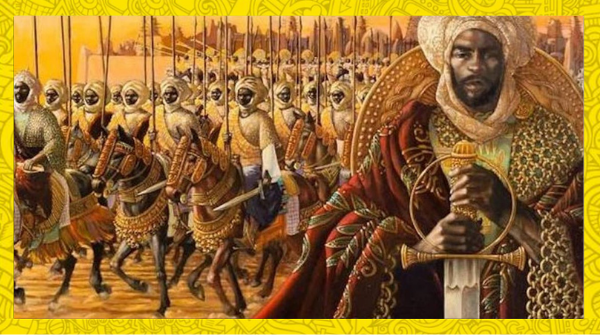
This way Musa gained control over major trade routes of Africa. His state Timbaktu was rich in natural resources like Gold and salt. His ever-growing empire was becoming more and more powerful as Musa gained control over trade routes connecting the Mediterranean sea. But despite his flourishing kingdom, the world remained unaware of his mass fortune until 1324.
In 1324, Musa made his pilgrimage to Mecca for Hajj. His expedition included a huge caravan of 60,000 men including an army of around 30,000 soldiers, slaves, and civilians all dressed in Persian silk and brocades. All of them carried 1.8 kg (4 lb) of gold bars and workers dressed in silks, who bore gold staffs, organized horses, and handled bags. The camels and horses carried an abundance of gold bars which Musa distributed within the poor. He also provided everyone with necessities and food for both humans and animals on their journey of over 2,700 miles.
On his voyage, he stopped at the cities like Cairo and Medina, distributing gold bars and coins to the poor, and also traded gold bars for souvenirs. it was reported that he built a mosque every Friday. His spendings even destabilized economies causing mass inflation. The sudden influx of gold in such cities devalued the metals for the next 10 years. Musa’s spending and donations created a massive ten-year gold recession. Thus on his way back, Musa borrowed the gold bars from money lenders on high interest. This was the only incident in history where one man controlled the price of gold.
His journey took a complete year and by the time Musa returned, stories of his mass wealth spread across nations and seas. Most historians argue, that Musa’s hajj pilgrimage was less of a religious devotion and more about showing off his wealth, in which he succeeded greatly. Mali and Musa’s status was elevated to almost legendary! But thanks to his voyage, Musa and Mali gained inclusion on the Catalan Atlas of 1375. It was one of the most important maps of Medieval Europe.
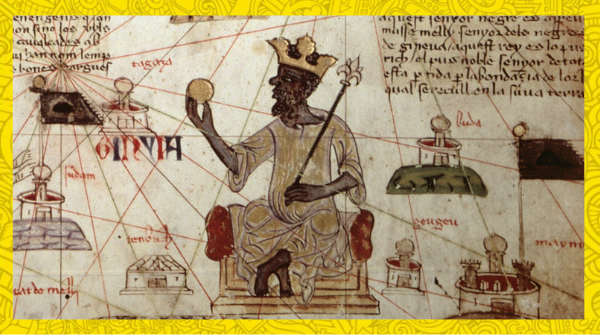
During Musa’s reign, he alone accounted for almost half of Old World’s gold. But despite his countless charity, his generous donations also caught the eyes of the world. Musa built several mosques and established numerous universities attracting Islamic scholars and students from across the world. The Mali Empire become highly urbanized with massive schools, universities, and religious places. He also encouraged art and architecture by building monuments like mosques across his highly populated towns.
Musa is credited for restaffing the University of Sankore in Timbaktu with astronomers and mathematicians. The university still stands intact in Timbaktu. After Mansa Musa died in 1337 aged 57, his successors were not capable enough of holding the huge empire and his sons crumbled the entire empire and ruled smaller states. The arrival of Europeans, later, finally annexed the whole empire.
Though his wealth and empire might not be left of his riches, Musa’s legacy continues to survive in the heart of the city. His reign is considered a golden era of Mali’s history. He is also regarded as the wealthiest man in history with wealth equivalent to US$400 billion, though some historians believe that his wealth is impossible to calculate accurately. He was richer than anyone could possibly describe.
“Contemporary accounts of Musa’s wealth are so breathless that it’s almost impossible to get a sense of just how wealthy and powerful he truly was,” Rudolph Butch Ware, associate professor of history at the University of California, said in an interview with the BBC.


0 Comments